
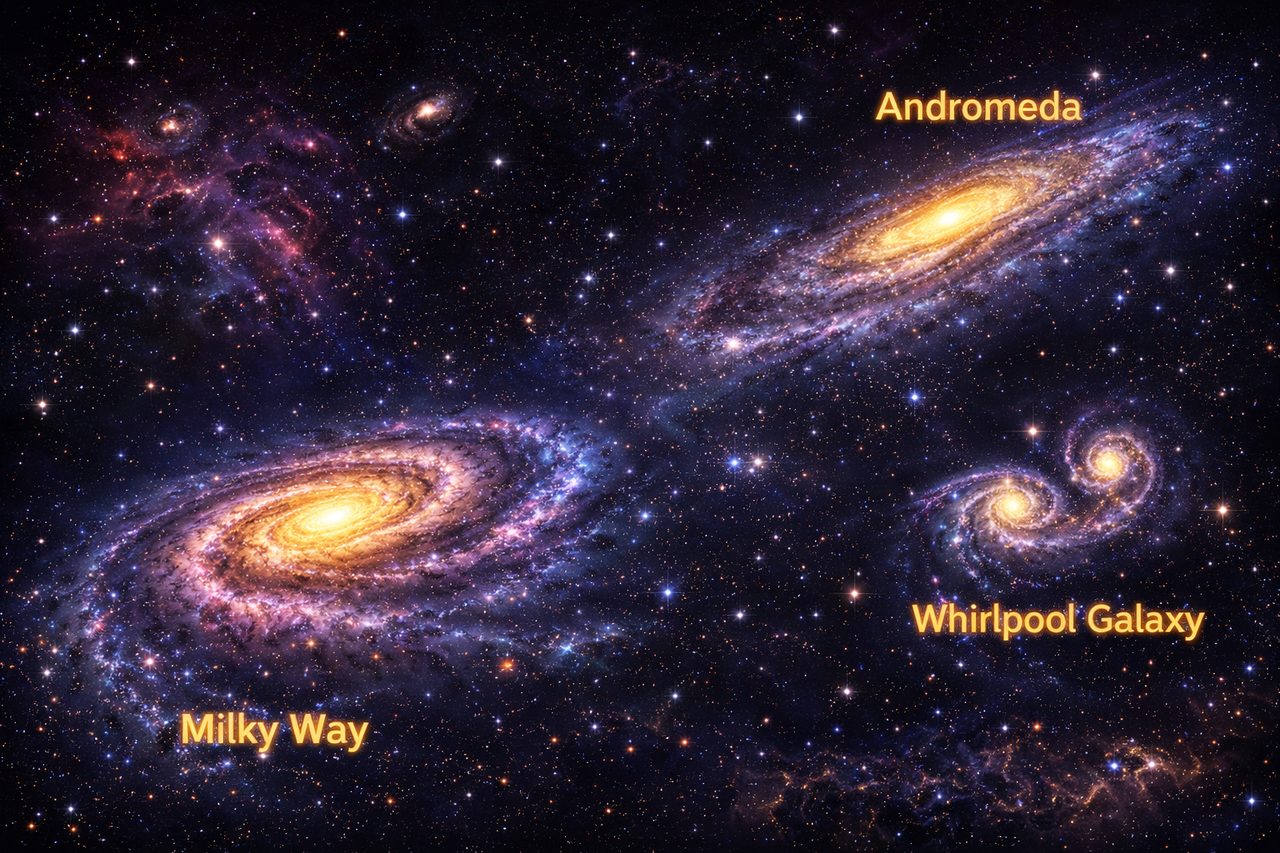
A bright neighbour
Andromeda is the most distant object easily visible to the unaided eye under dark skies. It appears as a faint smudge because its light is spread across a large area. Long-exposure images reveal a broad disk, dust lanes, star-forming regions and a central bulge.
Although Andromeda looks like one object, it contains a complex population of stars with different ages and chemical compositions. Its halo contains old stars and globular clusters, while the disk retains gas for ongoing star formation.
A history of encounters
Andromeda’s disk is not perfectly quiet. Streams of stars and distorted outer structures suggest that smaller galaxies have been absorbed in the past. Its satellite galaxies also trace the gravitational field and provide clues about how the large spiral assembled.
The galaxy’s central region contains a supermassive black hole and a dense concentration of stars. Observations at visible, infrared, radio and X-ray wavelengths separate the light from young stars, old stars, dust and energetic gas.
A future meeting with the Milky Way
The Milky Way and Andromeda are approaching one another because of gravity. In roughly four to five billion years they are expected to interact strongly. The process will take hundreds of millions of years and may produce long tidal tails and bursts of star formation.
Individual stars are unlikely to collide because the space between them is so large. The two galactic disks will be distorted, and the final remnant may become a larger elliptical or lenticular galaxy. The exact outcome depends on the orbit and on the influence of smaller companions.
Measuring distance and motion
Astronomers determine Andromeda’s distance with methods such as Cepheid variable stars, red-giant-branch stars and other standard candles. Its spectrum also shows a blueshift, revealing motion toward the Milky Way rather than away from us.
Distance measurements are the foundation for estimating luminosity, size and star-formation rate. A small change in distance can alter the inferred scale of every structure in the galaxy, which is why independent methods are compared carefully.
A laboratory for spiral galaxies
Andromeda is close enough to resolve individual star clusters and nebulae but large enough to represent a major spiral system. It offers a valuable comparison with the Milky Way, which we cannot observe from outside.
Together, M31 and the Milky Way show that spiral galaxies can share the same broad structure while differing in bulge size, gas content, satellite population and recent merger history.
A disk full of populations
Andromeda’s disk contains both bright young associations and older red stars. Infrared observations trace its dust and allow astronomers to estimate how much star formation is hidden from optical images. The galaxy’s outer halo is populated by globular clusters and faint stellar streams left by smaller galaxies. Mapping those streams is like reading the remains of a long sequence of mergers. The result is a picture of M31 as a living system assembled from many components rather than a perfect spiral that formed all at once.