
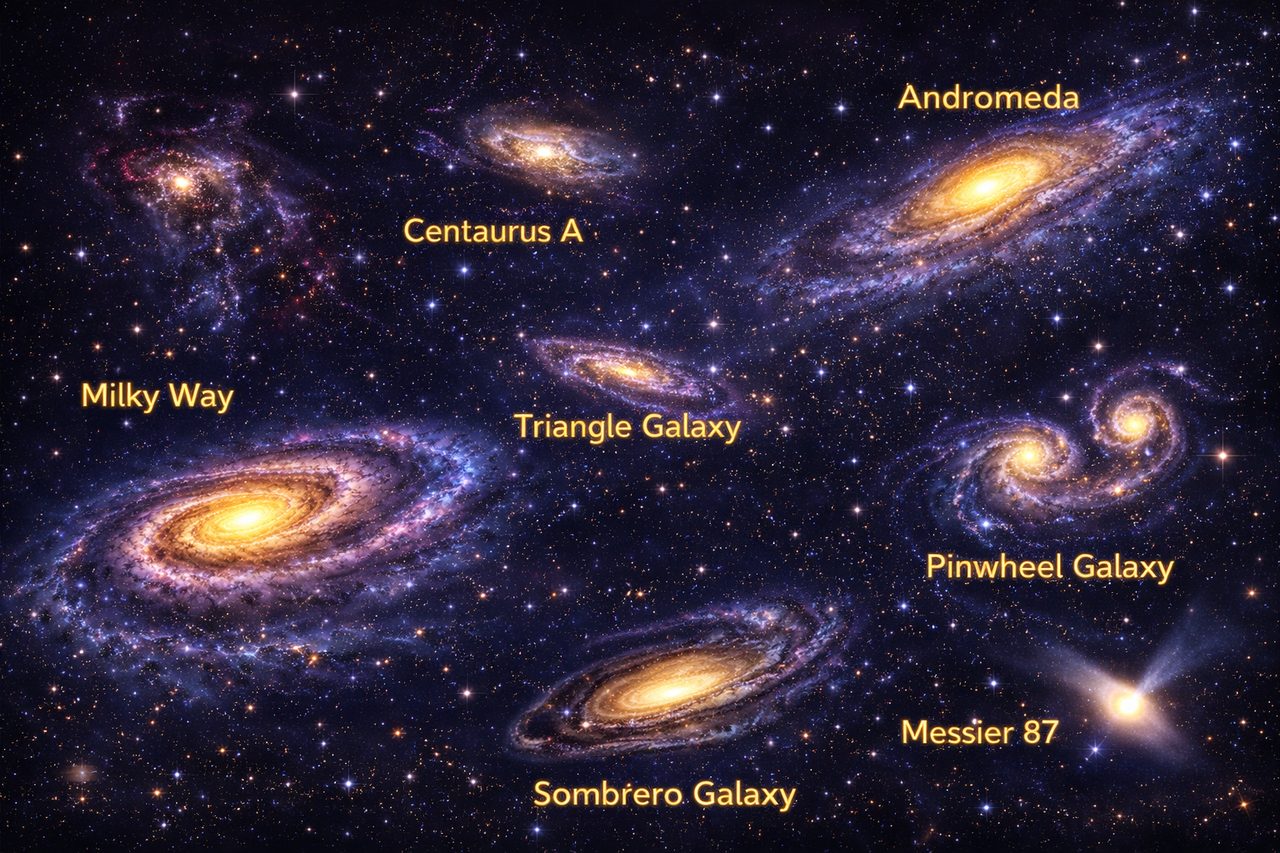
Galaxy and nebula
A galaxy is a gravitationally bound system of stars, gas, dust and dark matter. A nebula is a cloud of gas, dust or expanding stellar material. A galaxy can contain many nebulae, and a nebula can mark either the birth or death of stars.
A stellar nursery is a dense cloud where stars are forming. An emission nebula glows because energetic radiation ionises gas. A dark nebula blocks background light, while a planetary nebula is the expelled envelope of a dying Sun-like star.
Light-year and parsec
A light-year is the distance light travels in one year. It is about 9.46 trillion kilometres. A parsec is a geometric distance defined through stellar parallax and equals about 3.26 light-years.
Astronomers use kiloparsecs for the size of galaxies and megaparsecs for the distance between galaxies and clusters. These units are distances even though the word “year” appears in light-year.
Spectrum and redshift
A spectrum spreads light into wavelengths. Dark or bright lines reveal the atoms and molecules that absorbed or emitted the light. Spectroscopy can measure temperature, composition, velocity and magnetic effects.
Redshift moves spectral features toward longer wavelengths. For distant galaxies it is mainly associated with cosmic expansion, although local motion also contributes. Blueshift indicates motion toward the observer in the relevant frame.
Emission, reflection and absorption
Emission is light produced by an atom, molecule, hot gas or energetic particle. Reflection is light scattered by dust or a surface. Absorption occurs when matter removes selected wavelengths from a beam of light.
These processes create the colours and dark lanes seen in nebulae. Comparing them across wavelengths is more reliable than assigning a physical meaning to a colour in a processed image.
Dark matter and lensing
Dark matter is matter inferred from gravity rather than detected through its own light. Galaxy rotation, cluster motion and gravitational lensing show that visible stars and gas are not enough to explain many systems.
Gravitational lensing occurs when mass bends the path of light. Strong lensing can make arcs or multiple images; weak lensing subtly changes the shapes of many background galaxies. Both effects map invisible mass.
Pulsar, black hole and cluster
A pulsar is a rapidly rotating neutron star whose beams of radiation sweep across space. A black hole is a region from which light cannot escape once it crosses the event horizon. A cluster is a gravitational association of galaxies, hot gas and dark matter.
These objects occupy very different scales, but they are linked by energy and gravity. Pulsars illuminate supernova remnants, black holes influence galaxy centres and clusters reveal the cosmic web.
A useful habit when reading images
Whenever an image is presented, ask three questions: what wavelength or filter was used, what physical process produces the light, and how far away is the object? A red cloud may be glowing hydrogen, warm dust or a colour assigned to an infrared band. A dark lane may be empty space or dense dust. These questions prevent a processed image from being mistaken for a direct photograph in ordinary visible colour.