
The size of a light-year
Light travels about 299,792 kilometres per second in empty space. During one year it covers approximately 9.46 trillion kilometres. The number is large because a light-year is useful for stars, nebulae and galaxies rather than planets. The nearest star system is more than four light-years away.
Astronomers also use the parsec, based on the apparent shift of a nearby star as Earth moves around the Sun. One parsec equals about 3.26 light-years. Kiloparsecs and megaparsecs describe galactic and intergalactic distances.
Parallax for nearby stars
Parallax is the apparent change in a star’s position against distant background stars as Earth moves from one side of its orbit to the other. A closer star appears to shift more. Measuring this tiny angle gives a direct geometric distance.
Space missions such as Gaia measure positions and motions for enormous numbers of stars. Their distances anchor other methods, because the brightness of calibrated stars can then be compared with how bright those stars appear farther away.
Standard candles
Some objects have a predictable relationship between their intrinsic brightness and their measured properties. Cepheid variables pulsate in a way that links their period to their true luminosity. Type Ia supernovae reach similar peak brightnesses after careful calibration.
By comparing true brightness with observed brightness, astronomers estimate distances beyond the range of parallax. Each rung of this distance ladder must overlap the next, or a small error can propagate into measurements of the expansion of the universe.
Redshift and expansion
The spectral lines of a distant galaxy can be shifted toward longer, redder wavelengths. This redshift records the motion of the galaxy and, on cosmic scales, the expansion of space between us and the galaxy.
Redshift is not a simple ruler by itself. Astronomers combine it with cosmological models, standard candles, galaxy clustering and lensing. At very large distances, the light may have travelled for billions of years.
Looking into the past
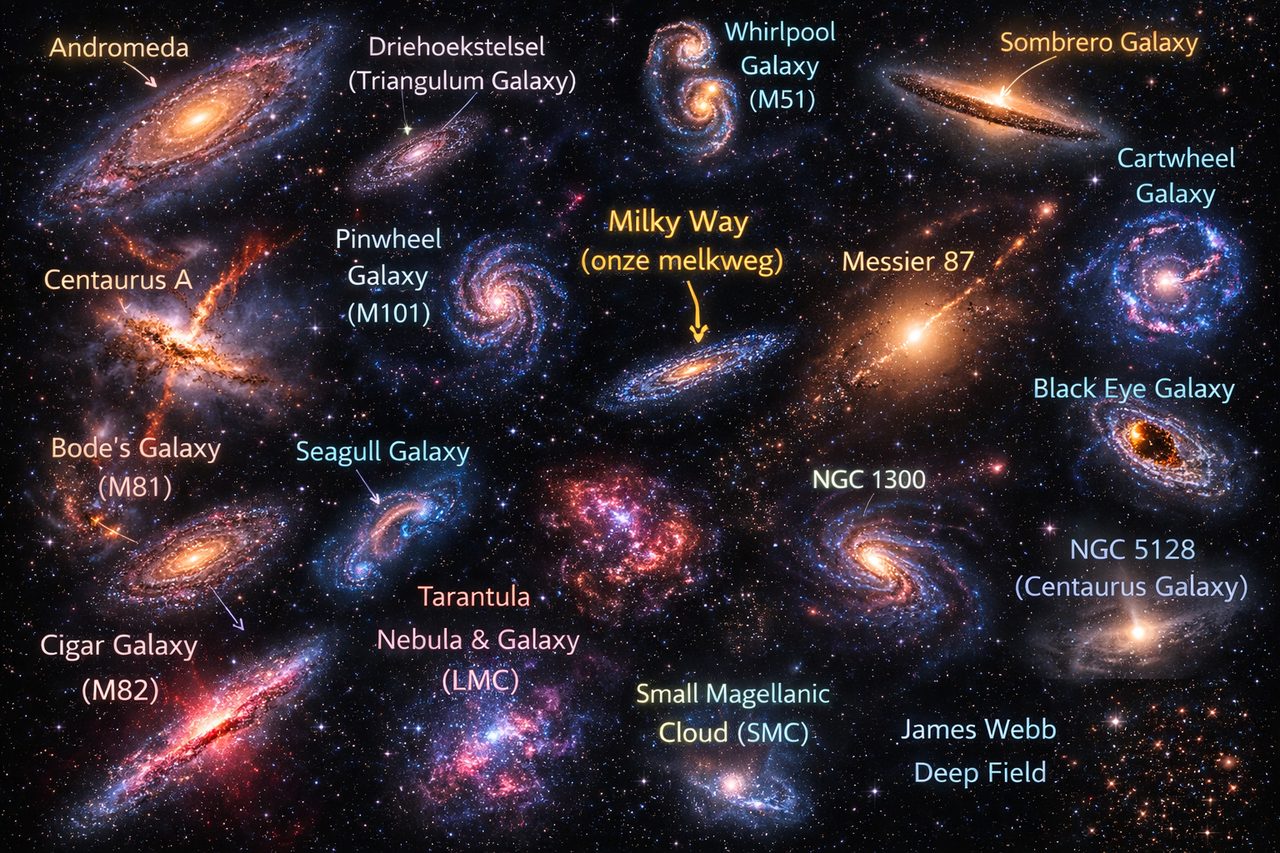
When we see the Orion Nebula, we see light that left it about 1,300 years ago. When telescopes observe a galaxy billions of light-years away, they see a younger universe. A deep image is therefore also a historical record.
This relationship lets astronomers compare galaxy populations at different ages. Nearby galaxies show detailed structure today, while distant galaxies reveal how disks, black holes and clusters formed over cosmic time.
Why every distance has uncertainty
A distance is not a single observation but the result of a chain of measurements. Parallax can anchor nearby stars, variable stars can extend the scale, and supernovae or redshift can reach farther still. Dust, metallicity and calibration can affect each rung. Astronomers compare independent methods because a small systematic error repeated across millions of objects can change the inferred age, size or expansion rate of the universe.