
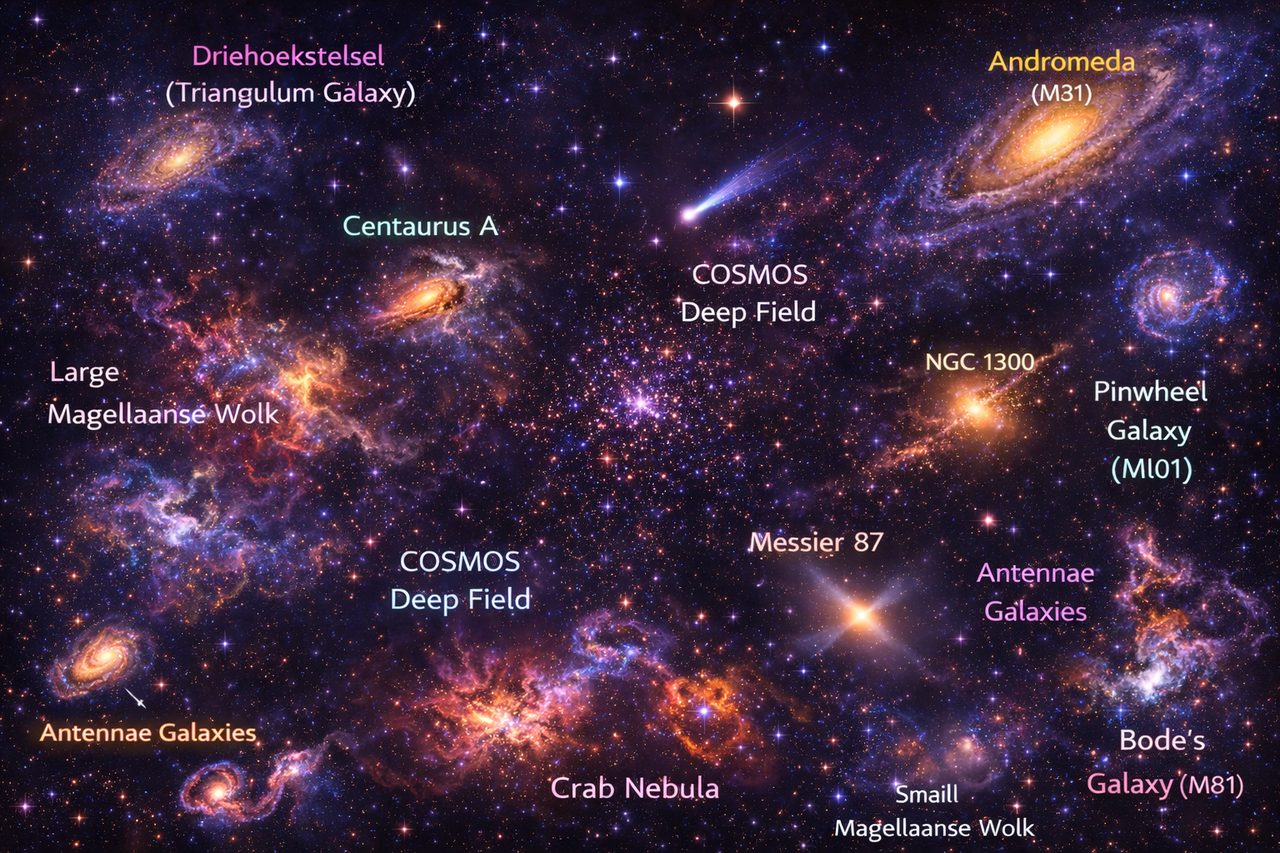
A galaxy with a split appearance
In visible light, Centaurus A shows a broad dark band of dust crossing a bright central body. The dust lane is the remnant of a disrupted disk, probably left by a merger between a large elliptical galaxy and a smaller gas-rich spiral.
The merger supplied cold gas and dust to the central region. It also disturbed the orbits of stars, leaving a system that looks neither like a quiet elliptical nor like an undisturbed spiral.
A powerful central engine
At the centre of Centaurus A is a supermassive black hole surrounded by hot gas. Material falling inward forms an accretion disk and launches jets of particles moving close to the speed of light.
The jets are visible in radio and X-ray wavelengths and extend far beyond the optical body. Their interaction with surrounding gas can heat it, suppressing or triggering star formation depending on the location and energy involved.
Radio lobes and invisible structure
The enormous radio lobes of Centaurus A are filled with relativistic particles and magnetic fields. They are much larger than the bright central galaxy and record repeated episodes of activity from the black hole.
Radio maps reveal structures that optical images cannot show. Comparing radio, X-ray, infrared and visible data allows astronomers to separate old jet plasma, hot gas, dust and young stars.
A laboratory for mergers
The disturbed dust lane and shells around Centaurus A preserve evidence of a collision. Mergers can build bulges, rearrange stars and deliver gas to the centre. They are one of the main ways galaxies grow in the hierarchical universe.
Because Centaurus A is relatively nearby, individual star clusters and gas clouds can be studied in detail. It offers a bridge between local observations and the distant active galaxies seen when the universe was younger.
Why Centaurus A matters
Centaurus A shows that a black hole can influence a region far larger than its immediate surroundings. Its jets transport energy into the halo and alter the conditions for future gas cooling.
The galaxy also demonstrates why no single image tells the whole story. The familiar dust lane is only the visible part of a system that includes an active nucleus, extended lobes, hot gas and a long merger history.
The dust lane as a timeline
The dust lane is more than a dark feature in a photograph. Its position, temperature and motion show how a smaller gas-rich galaxy was disrupted by the larger system. Cold molecular clouds survived the encounter and were carried toward the centre, where some may form stars and some may feed the black hole. The lane therefore preserves both the collision history and the ongoing exchange between gas, star formation and nuclear activity.