
A small galaxy with a big role
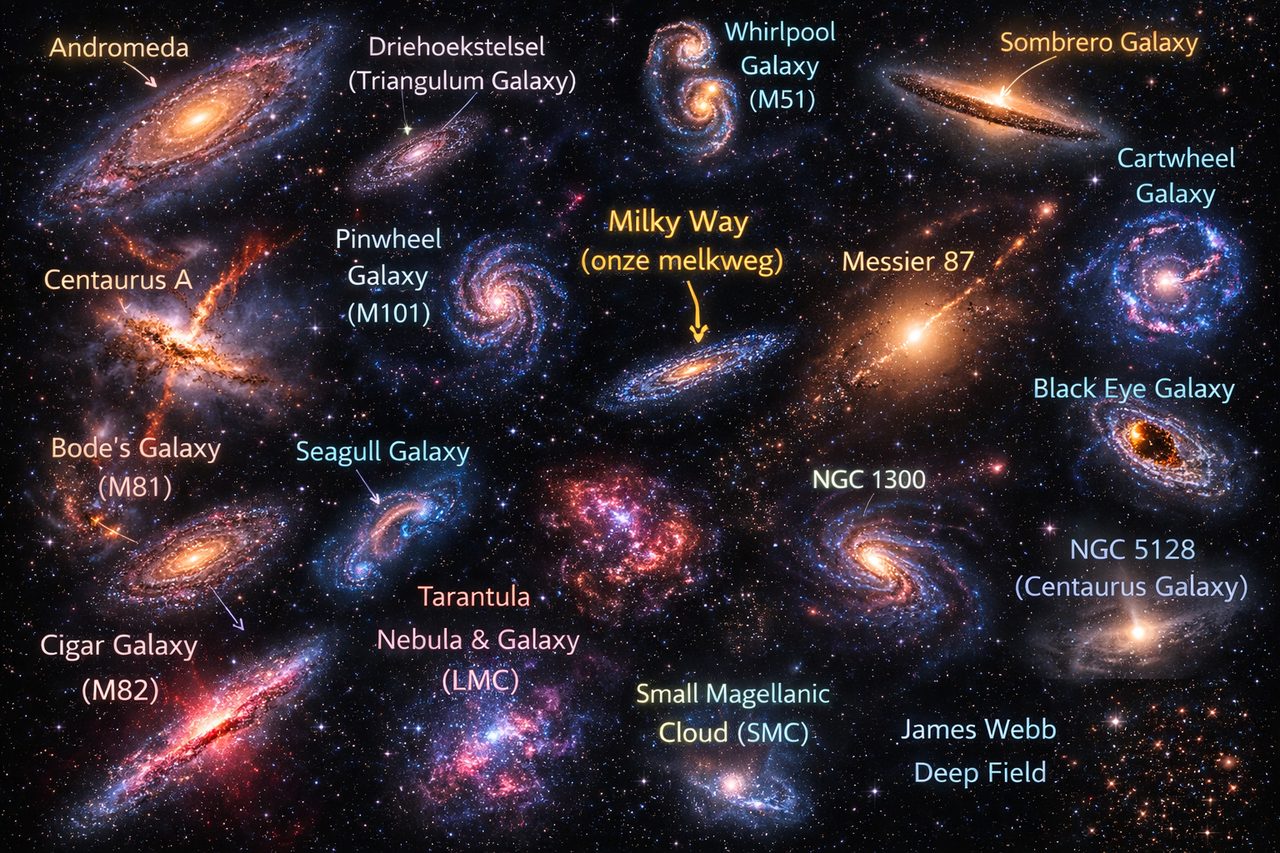
The Large Magellanic Cloud is smaller than the Milky Way but large enough to contain millions or billions of stars, a substantial gas reservoir and many star clusters. Its irregular appearance reflects its interaction with the Milky Way and the Small Magellanic Cloud.
Because it is nearby, individual stars and nebulae can be resolved far better than in most external galaxies. Astronomers use it to test stellar evolution, distance measurements and the physics of star-forming regions.
The Tarantula Nebula
The Tarantula Nebula is the most active star-forming region in the Local Group outside the Milky Way. Massive young stars flood the surrounding gas with ultraviolet radiation, sculpting cavities and bright filaments.
The region contains dense clusters and stars that are much more massive than the Sun. Studying it shows how stellar winds and supernovae can both trigger and suppress later generations of star formation.
A famous supernova
Supernova 1987A exploded in the Large Magellanic Cloud and became the closest naked-eye supernova observed in centuries. Its light curve and expanding rings were studied across the electromagnetic spectrum.
The event provided direct evidence about how massive stars explode, create heavy elements and distribute material into space. Its remnant continues to change as the shock wave meets surrounding gas.
Gas, motion and interaction
The Large Magellanic Cloud contains abundant neutral hydrogen and has a warped structure. Tidal forces from the Milky Way and the Small Magellanic Cloud pull on its gas and stars, changing its orbit and internal shape.
The Magellanic Stream, a long trail of gas across the sky, records the interaction between the two satellite galaxies and the Milky Way’s hot halo. It is an example of galactic matter existing far beyond the visible disk.
A nearby comparison galaxy
The Large Magellanic Cloud has fewer heavy elements than the Milky Way, making it a useful comparison with conditions that were more common in the early universe. Its proximity lets astronomers study individual stars while still seeing a complete galaxy.
Its star clusters, nebulae, gas clouds and supernova remnants connect small-scale stellar physics with the growth of a galaxy. Few other external systems offer such a detailed view.
A distance anchor
The Large Magellanic Cloud is important for the cosmic distance scale because its Cepheid variables and other standard candles can be measured in detail. Its distance is close enough for individual stars to be identified but far enough to represent an external galaxy. Accurate measurements of its stars help calibrate distances to more remote galaxies, supernovae and galaxy clusters. A small satellite galaxy can therefore influence our estimate of the size and expansion of the universe.