
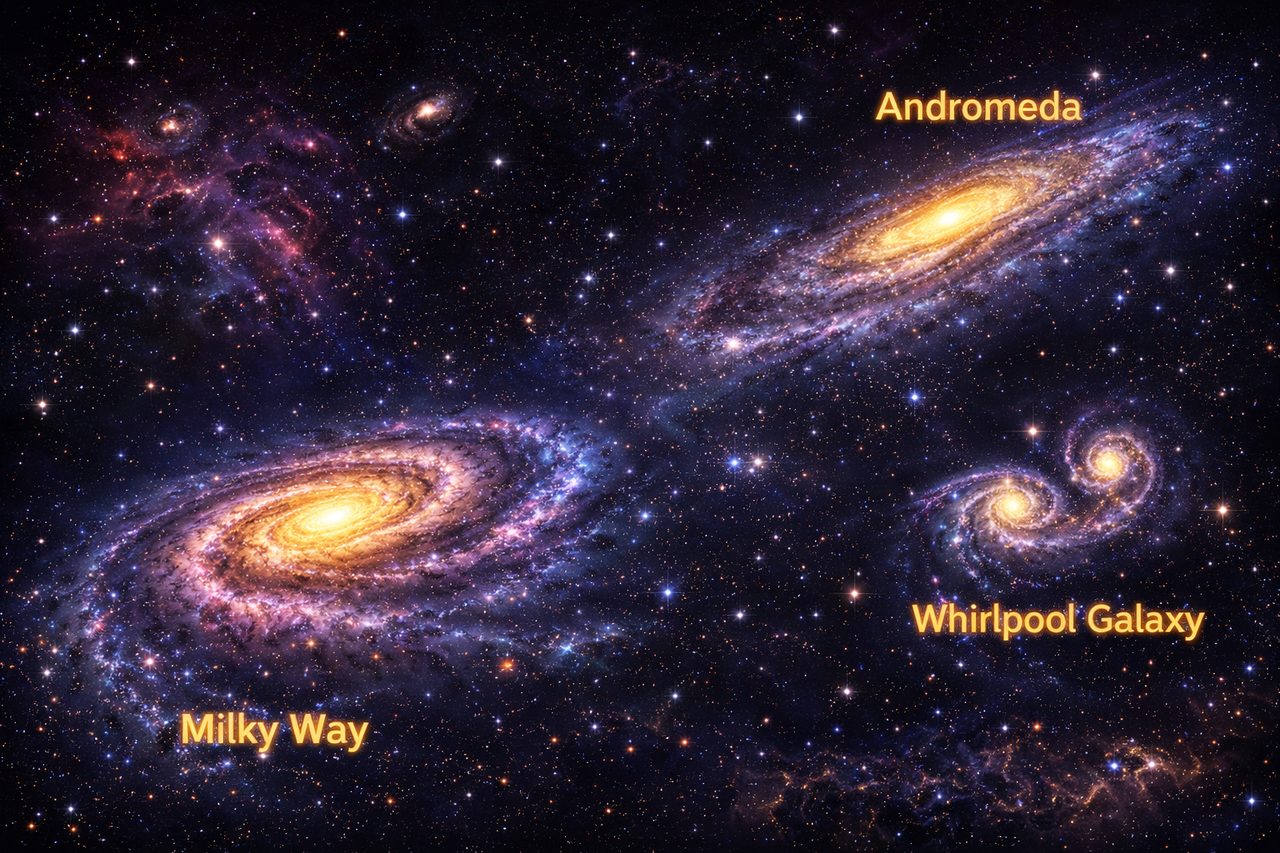
A galaxy seen from within
From Earth, the Milky Way appears as a pale band across the night sky because we are looking along the dense plane of our galaxy’s disk. Dust blocks visible light in many directions, but infrared and radio observations reveal the structure behind the dark lanes.
The Milky Way contains a thin disk of gas and young stars, a thicker disk of older stars, a central bulge and a faint stellar halo. Globular clusters orbit far above and below the disk and preserve some of the oldest stellar populations in the galaxy.
The spiral disk and central bar
The Milky Way is a barred spiral galaxy. A long concentration of stars crosses the central region, and spiral arms extend from it. The Sun lies about 26,000 light-years from the centre in a smaller feature often called the Orion Spur, between larger arms.
The Galaxy rotates differentially: stars closer to the centre orbit faster than those farther out. The pattern of spiral arms, gas clouds and star-forming regions is shaped by this rotation, density waves, magnetic fields and gravitational interactions with satellite galaxies.
Sagittarius A*
At the centre of the Milky Way is Sagittarius A*, a supermassive black hole with a mass of roughly four million Suns. It does not pull in everything around it like a cosmic vacuum cleaner; stars orbit it at great speeds and most remain safely distant.
Infrared telescopes track individual stars around the central object. Their orbits provide one of the strongest measurements of a supermassive black hole’s mass. Gas clouds, magnetic fields and occasional flares reveal a much more active environment than the quiet neighbourhood around the Sun.
Birthplaces and stellar remains
The disk contains cold molecular clouds where new stars form. The Orion Nebula is one nearby example of a stellar nursery, while supernova remnants and planetary nebulae show how stars return material to space. The cycle changes the chemical composition of the Galaxy over time.
White dwarfs, neutron stars and black holes are the compact remains of earlier stars. Their distribution, motion and ages help astronomers reconstruct the Milky Way’s history and the mergers that built its halo.
The Local Group
The Milky Way is not alone. It is one of the largest members of the Local Group, a collection of dozens of galaxies dominated by the Milky Way, Andromeda and the Triangulum Galaxy. Many smaller dwarf galaxies orbit the two large spirals.
The Milky Way and Andromeda are moving toward one another and will interact in several billion years. The future encounter will rearrange stars and gas, but direct stellar collisions will be rare because the distances between stars are enormous.