
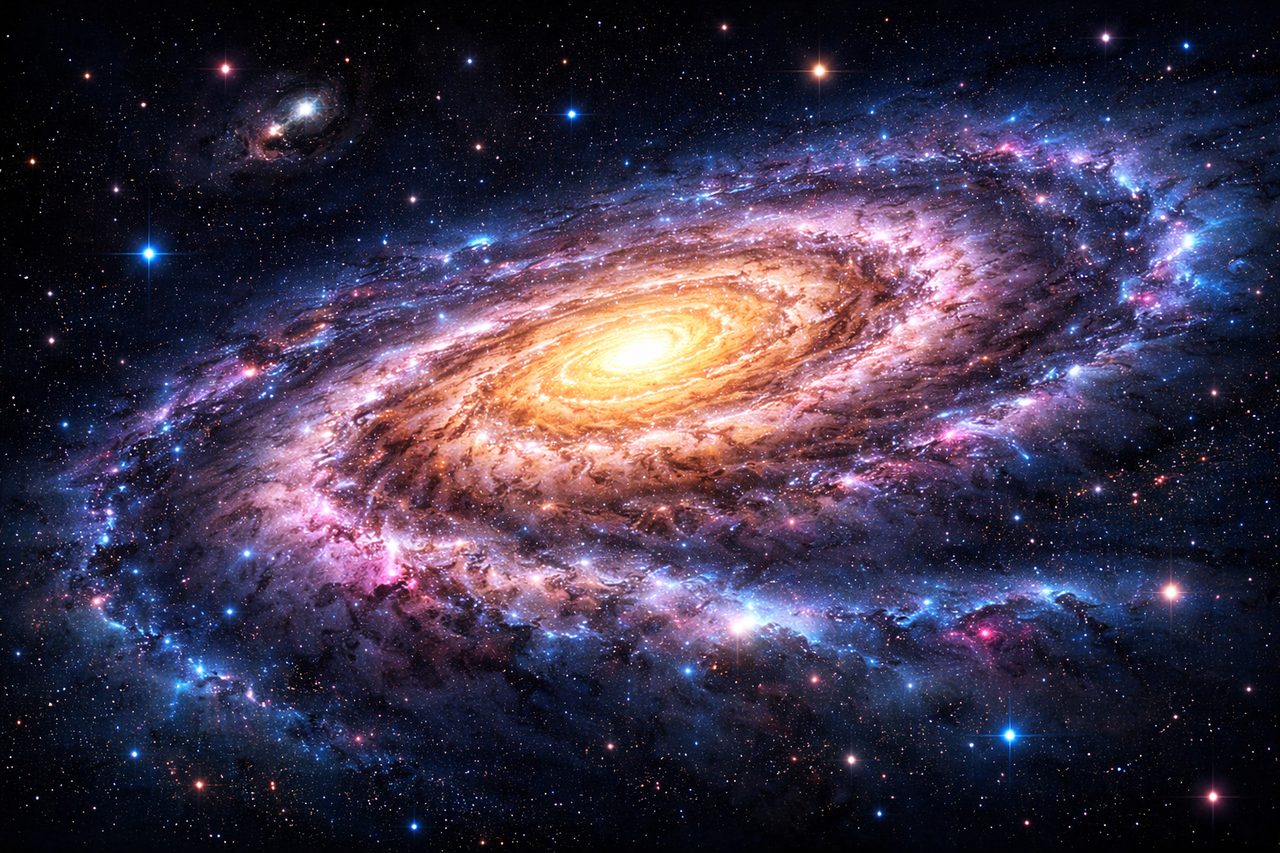
A spiral with an uneven disk
M101 is seen almost face-on, so its arms are easy to follow from the centre to the outer disk. They are not perfectly balanced: one side is more extended and brighter than the other. A close passage with a companion galaxy may have disturbed the gas and amplified the asymmetry.
The disk is larger than the Milky Way’s visible disk, but its surface brightness is relatively low. The galaxy contains many low-density outer regions where faint star formation continues beyond the most obvious arms.
Bright H II regions
The arms of M101 contain hundreds of H II regions, where ultraviolet light from newborn massive stars ionises hydrogen. These clouds glow in emission lines and appear as pink or red knots in processed images.
The sizes and brightnesses of the regions tell astronomers how clusters form and how efficiently gas turns into stars. Infrared data reveal the dust-hidden part of the process, while radio maps trace cold hydrogen and molecules.
Companions and tidal forces
Several small galaxies orbit M101. Their gravity can pull on the disk, create streams and change the shape of the spiral arms. A tidal interaction does not need to produce a dramatic collision to have a measurable effect.
The companions also provide clues about the dark-matter halo. Their orbits depend on the total mass of M101, including material that emits no light and extends far beyond the visible stars.
Explosions in a nearby galaxy
M101 has hosted several observed supernovae. Each event provides a temporary beacon that can be followed across time. Type Ia supernovae are especially useful because their intrinsic brightness can be calibrated and used for distance measurements.
Core-collapse supernovae reveal the death of massive stars and return newly made elements to the interstellar medium. A single galaxy can therefore connect distance cosmology with stellar evolution.
A wide view of spiral growth
M101 is close enough for observers to study individual star-forming complexes while still showing the full structure of a large galaxy. Its low surface brightness and uneven arms make it a useful contrast with the Whirlpool Galaxy.
Together, these spirals show that galaxy shape is not fixed. Gas supply, companions, dark matter, star formation and internal rotation all contribute to the image we see.
The outer disk
The outer disk of M101 is especially useful because its gas remains diffuse and its surface brightness is low. Some star-forming regions lie far from the centre, where the chemical abundance is lower and the gravitational environment is different. Comparing inner and outer regions shows how a galaxy’s history is written as a gradient in gas, metals, dust and stellar age. The same kind of gradient can be measured in the Milky Way and nearby spiral galaxies.