
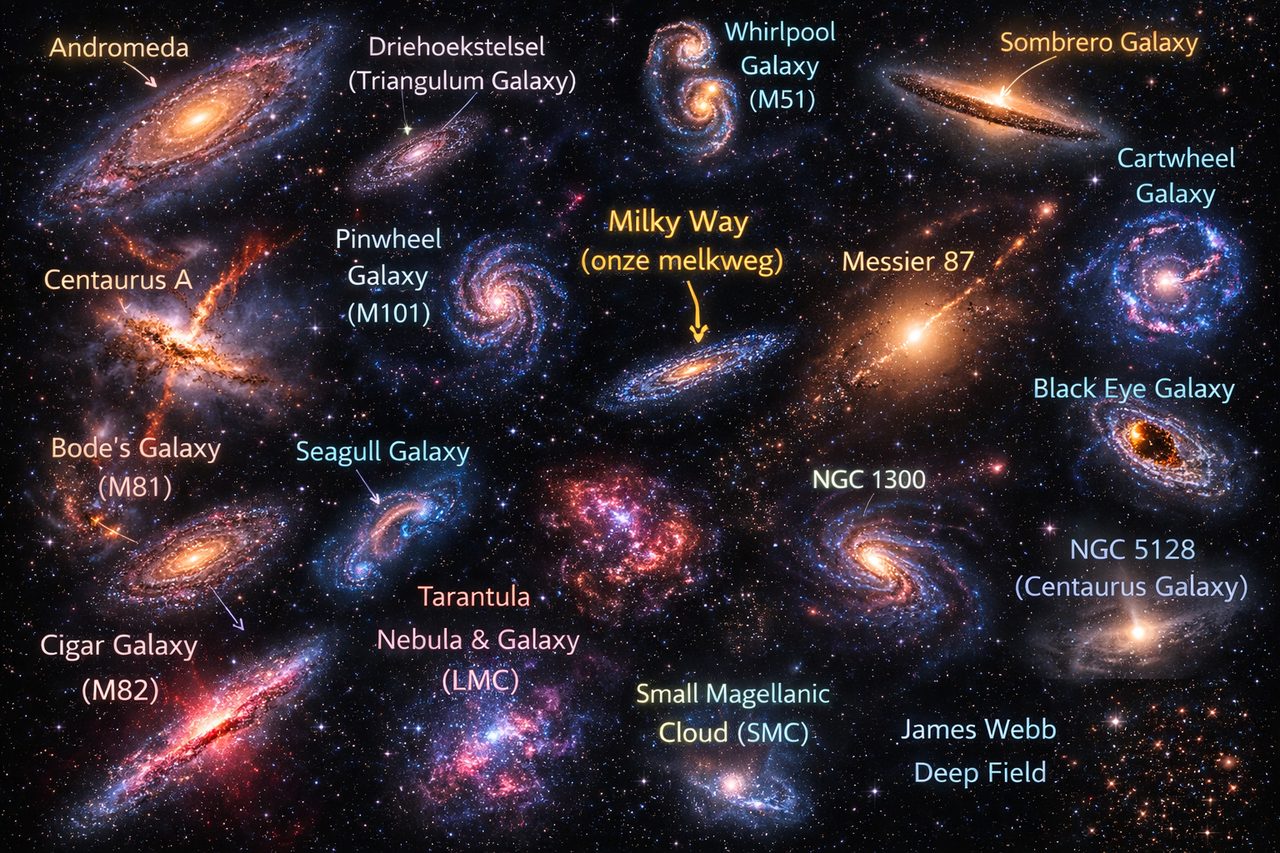
A galaxy without a stable spiral
The Small Magellanic Cloud does not have the smooth disk and arms of a large spiral. Its stellar body is elongated and disturbed, with regions of different ages. The shape reflects the gravitational influence of the Milky Way and the Large Magellanic Cloud.
Irregular galaxies are not necessarily simple. The SMC contains old globular clusters, young associations, molecular clouds and active star-forming regions. The challenge is to understand how these components evolved while the galaxy was being pulled apart.
A lower-metallicity environment
The Small Magellanic Cloud contains fewer elements heavier than helium than the Milky Way. This lower metallicity changes the way stars lose mass, how dust forms and how massive stars evolve.
Astronomers use SMC stars to study conditions that resemble parts of the early universe. The galaxy is close enough to resolve individual stars, but its composition is different enough to reveal how chemistry influences stellar life cycles.
Star clusters and nebulae
The SMC contains many open clusters and bright emission regions. Ultraviolet light from young stars ionises gas, creating glowing hydrogen nebulae. Infrared observations find embedded stars that remain hidden behind dust in visible images.
Cluster ages can be measured by comparing the positions of stars on the Hertzsprung–Russell diagram. This creates a timeline of when different parts of the galaxy formed stars and how interactions may have changed the rate.
The Magellanic Stream
A long ribbon of neutral hydrogen connects the Magellanic Clouds and extends across a large part of the sky. The Milky Way’s gravity and hot halo affect the gas, stripping material from the satellites and shaping its motion.
The stream is difficult to see in ordinary optical images because it is extremely diffuse. Radio telescopes map it directly and reveal how a large galaxy can alter the gas supply of its smaller companions.
The future of the SMC
The Small Magellanic Cloud is likely to remain a satellite of the Milky Way while interacting with the Large Cloud. Over long timescales, tidal forces may stretch it further, remove gas and change its orbit.
Its present appearance is therefore one moment in a continuing history. Studying it helps explain how dwarf galaxies survive, form stars and become incorporated into larger systems.
Cepheids and the distance ladder
The Small Magellanic Cloud contains many pulsating Cepheid variables. Their periods and brightnesses can be compared because the stars are all in the same nearby galaxy, reducing some distance uncertainties. These measurements help calibrate the relationship used to estimate distances in more remote galaxies. The SMC therefore links local stellar physics to cosmology while also providing a natural experiment in a low-metallicity environment.