
A smaller spiral with open arms
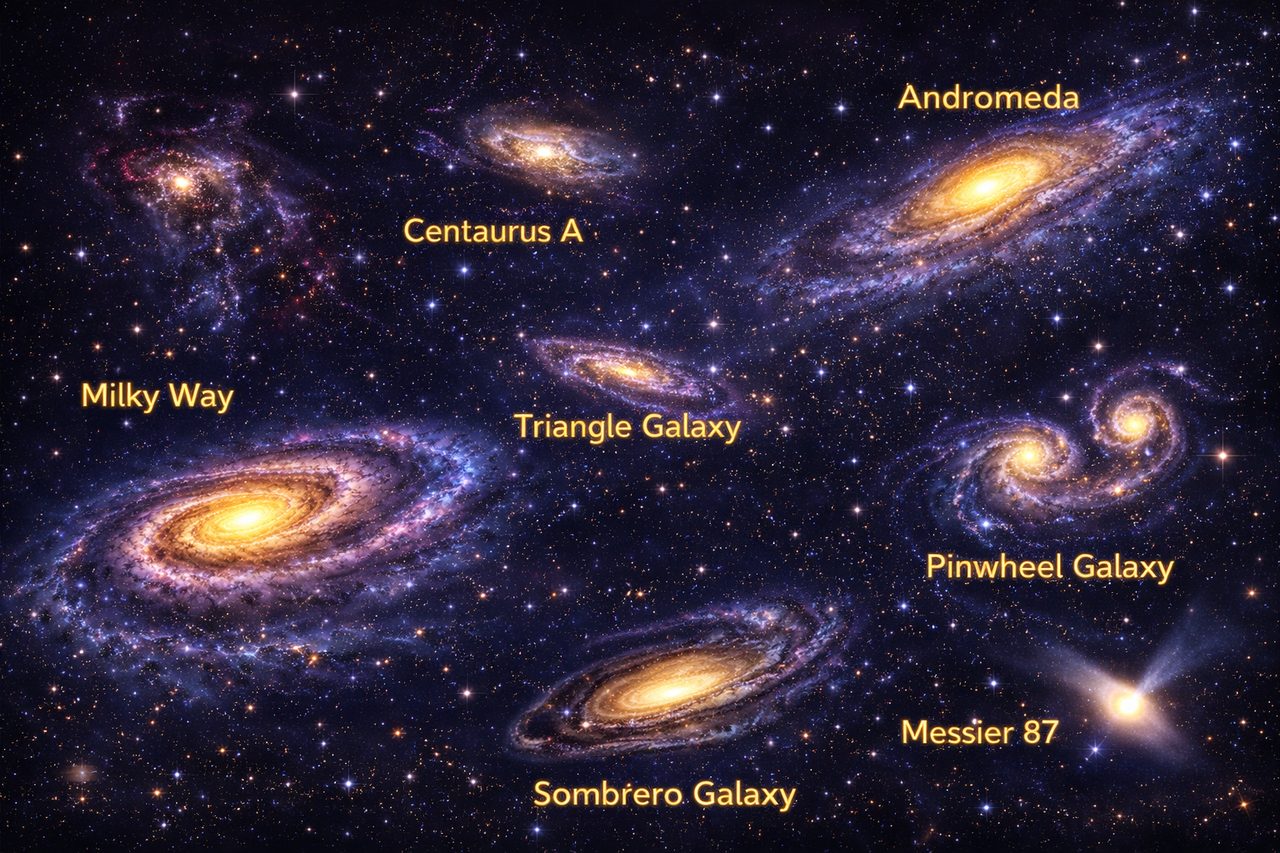
The Triangulum Galaxy has a loose, open spiral structure and a much less prominent central bulge than Andromeda or the Milky Way. Its lower mass makes it easier for gas to remain visible in the disk, and the arms contain many young, blue stars.
M33 is tilted so that astronomers can study much of its disk without looking directly through the densest plane. Images reveal dust lanes, pink emission nebulae and clusters of hot stars scattered along the arms.
NGC 604 and stellar nurseries
One of M33’s most famous regions is NGC 604, a giant emission nebula where massive stars ionise surrounding hydrogen gas. It is far larger and more luminous than the Orion Nebula and contains many young stars packed into a relatively small volume.
Emission regions such as NGC 604 show how a galaxy converts cold gas into stars. Ultraviolet radiation from the newborn stars strips electrons from hydrogen, producing the red glow seen in long-exposure images.
Gas and chemical enrichment
M33 contains abundant hydrogen gas, including a large extended reservoir beyond the bright optical disk. This gas can feed future star formation, although the rate changes with local density, turbulence and gravitational interactions.
The chemical abundance in M33 varies with distance from the centre. The inner disk contains more elements made by previous generations of stars, while the outer regions are more primitive. This gradient records how enrichment spreads through a galaxy.
A companion in the Local Group
M33 is gravitationally linked to Andromeda and may have interacted with it in the past. Its future orbit is not completely settled because the masses and dark-matter halos of the two galaxies are difficult to measure.
The Local Group gives astronomers a nearby sample of different systems: two large spirals and one smaller, gas-rich spiral. Comparing their shapes and star-formation histories tests models of galaxy growth in a quiet environment.
How we observe M33
Individual Cepheid variables, red giants and star clusters can be detected in M33, allowing distance and age measurements. Radio maps trace its neutral hydrogen, while infrared telescopes reveal dust and embedded young stars.
M33 is therefore more than a faint patch in the sky. It is a resolved laboratory where the life cycle of gas, stars and nebulae can be studied across an entire galaxy.
A nearby view of star formation
M33 is close enough that astronomers can study individual star clusters and measure their ages across the disk. Its spiral arms contain bright gas clouds, while the outer regions preserve a large reservoir of neutral hydrogen. The combination makes the galaxy useful for tracking how gas moves inward, where stars form and how chemical enrichment changes with radius. It is a smaller system, but its details are unusually accessible.