
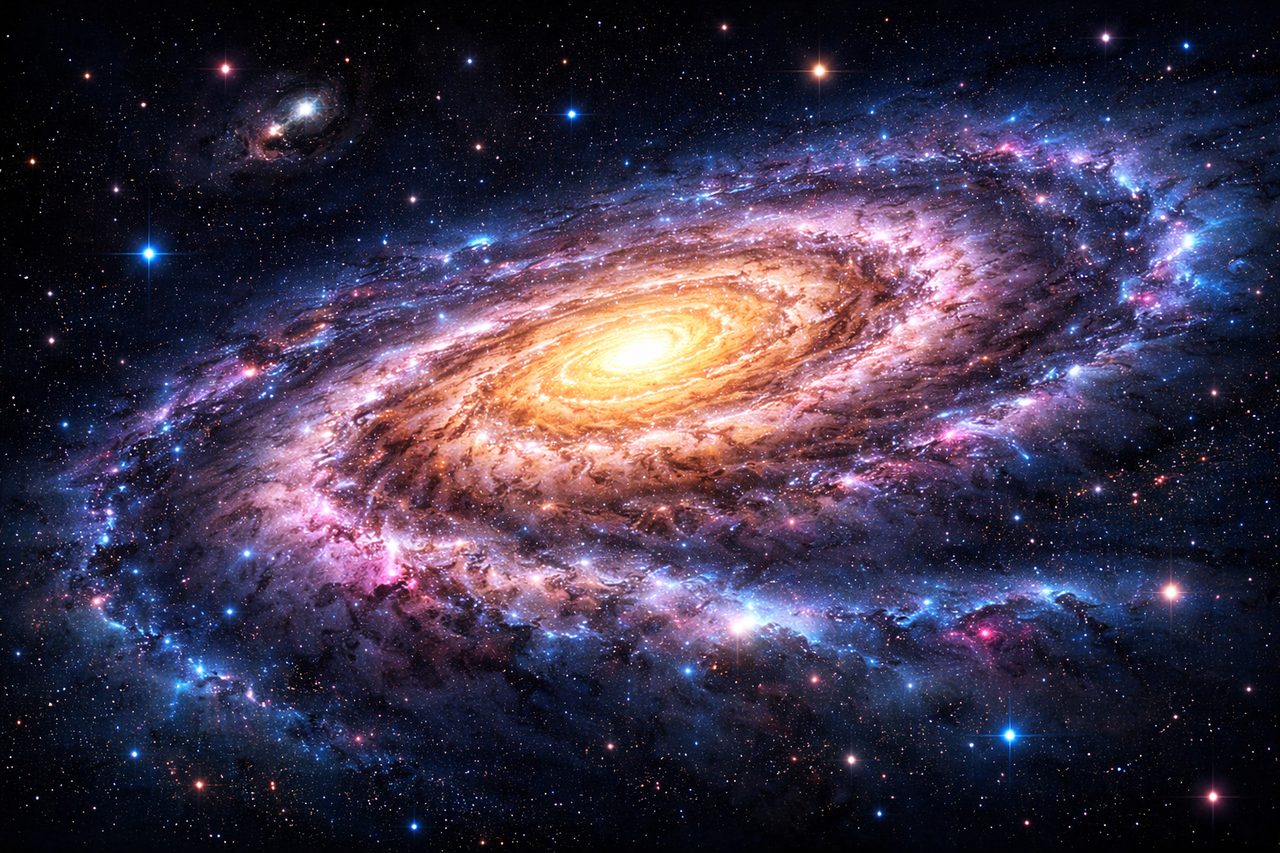
A spiral seen from above
The Whirlpool Galaxy is oriented so that we see much of its disk face-on. Its arms form an obvious pattern of blue young stars, pink emission nebulae and dark dust lanes. This orientation makes M51 a favourite target for studying how spiral structure connects to star formation.
The arms are density patterns rather than permanent rows of stars. As gas moves through them, it can be compressed, cool and collapse into new stars. The bright colours therefore trace different physical components of the disk.
The influence of NGC 5195
A smaller companion galaxy, NGC 5195, lies near the end of one of M51’s arms. The two galaxies are interacting through gravity. Their encounter has pulled out streams, compressed gas and strengthened the visible spiral pattern.
The timing of the encounter is still modelled with simulations. A close passage can produce an elegant structure for a short astronomical interval, then gradually transform the disk as the companion moves away or merges.
Star formation and dust
M51’s arms are crowded with molecular clouds, young clusters and H II regions. Infrared observations see warm dust hidden from optical telescopes, while radio observations reveal cold gas. Comparing the wavelengths shows how much star formation is obscured by dust.
Massive stars live briefly and end as supernovae, so their presence marks recent activity. Supernova remnants inject energy and heavy elements into the gas, affecting the next generation of clouds.
A central engine
The centre of M51 contains a supermassive black hole, although its activity is less visually dramatic than the arms. X-ray and infrared observations can identify hot gas and compact sources near the nucleus.
The central region also helps astronomers compare bulge growth with disk evolution. Interactions can funnel gas inward, feed the nucleus and trigger both star formation and black-hole accretion.
Why M51 matters
The Whirlpool Galaxy offers a close, high-contrast example of galaxy interaction. Its arms can be studied in detail while the overall system remains large enough to test simulations of tidal forces.
M51 reminds us that a galaxy’s appearance is often temporary. The shape seen in a photograph is the visible result of orbital motion, gas physics, star birth, dust and the influence of a companion.
Two galaxies, one experiment
The Whirlpool pair is a natural experiment because the companion’s gravitational pull is visible in the shape of the main disk. Simulations can reproduce the arms only when the orbit, mass ratio and gas response are treated together. Comparing those models with star clusters, dust lanes and neutral hydrogen tests how density waves arise. M51 is therefore not just a pretty spiral; it is a measurement of how gravity reorganises a galaxy.